
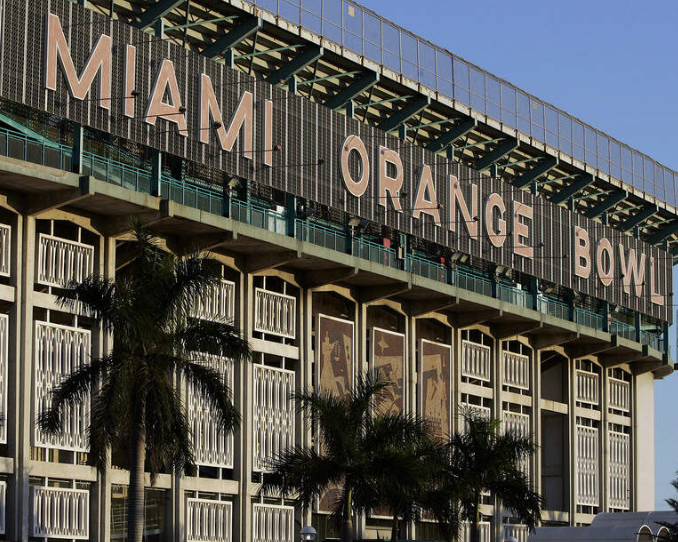
There are stadiums where college football is played.
And then there are stadiums that become part of the story.
For the University of Miami, the Orange Bowl was the latter.
From the late 1930s through 2007, generations of Hurricanes walked onto the field in the heart of Miami, creating some of the most memorable moments in college football history.
Today, Miami plays its home games at Hard Rock Stadium in Miami Gardens, a modern facility that looks and feels a world away from the old Orange Bowl.
The Orange Bowl is gone. But its legacy isn’t.

THEN: The Orange Bowl
The stadium opened in 1937 as Roddy Burdine Municipal Stadium, then was renamed the Orange Bowl in 1959.
For 71 seasons, it was UM’s home.
Miami played 468 games there, compiling a 318-143-7 record (312-140-7 in the regular season; 6-3 in bowl games).
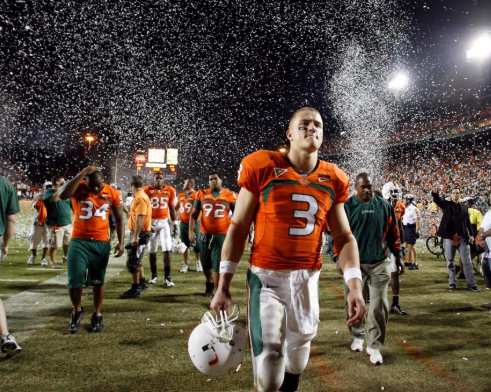
During the 1980s, the Hurricanes went 52-6 at the Orange Bowl.
That’s more than a good home-field advantage.
That’s an identity.
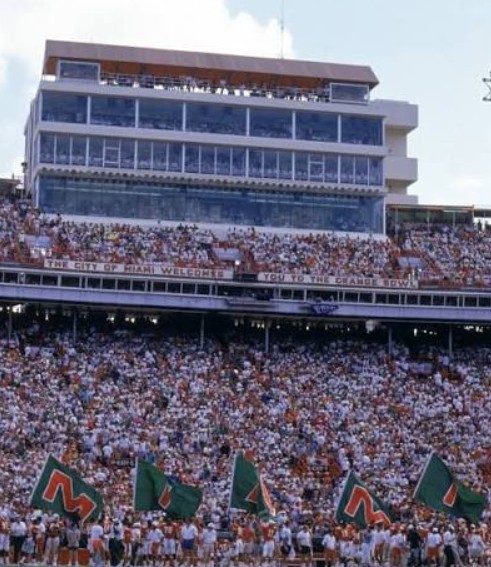
The Orange Bowl was close to campus, about 8 miles from Coral Gables, and surrounded by neighborhoods. It was built in an era when the stadium could feel like part of the game.
There were no giant video boards, luxury suites or modern canopies.
There was concrete.
There was noise.
And there was Miami football.

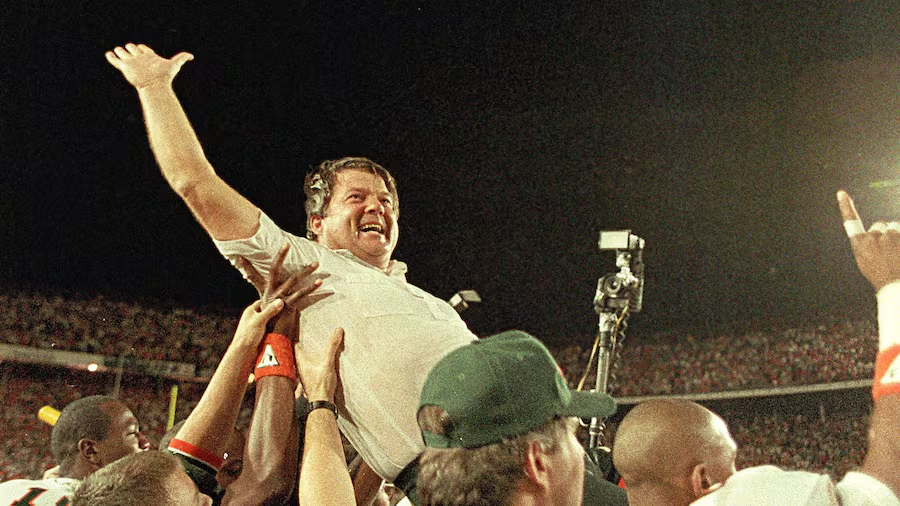
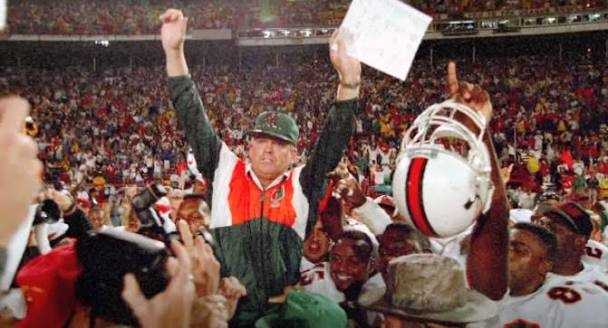

Miami Herald file photos
The decade that changed everything
The Orange Bowl became the backdrop for the rise of Miami football from a regional program into a national power.
In the 1980s, the Hurricanes won national championships following the 1983 and 1987 seasons, with both title-clinching games taking place in the Orange Bowl.
The 1983 championship remains one of college football’s iconic games: Miami defeated Nebraska 31-30 in the Orange Bowl, stopping the Cornhuskers’ two-point conversion attempt in the final seconds.

1984 Orange Bowl and win its first national championship.
Miami Herald file photo
Four years later, Miami completed a 12-0 season by defeating Oklahoma 20-14 in the 1988 Orange Bowl.
And the story didn’t end there.
Miami won another national championship at the Orange Bowl following the 1991 season, again beating Nebraska, this time 22-0, for its fourth title in nine years. (The Canes beat Alabama 33-25 at the Sugar Bowl in New Orleans to win the 1989 crown).
The Orange Bowl wasn’t simply where Miami played.
It was where the legend of Hurricanes football was built.

By the numbers
- 71 — seasons Miami played at the Orange Bowl
- 459 — regular-season home games
- 312-140-7 — regular-season record at the Orange Bowl
- 58 — straight home wins from 1985-94, an NCAA record at the time
- 81,927 — largest Miami crowd at the Orange Bowl, against Florida State in 2002. Remember all the Wide Right games? This one was Wide Left.
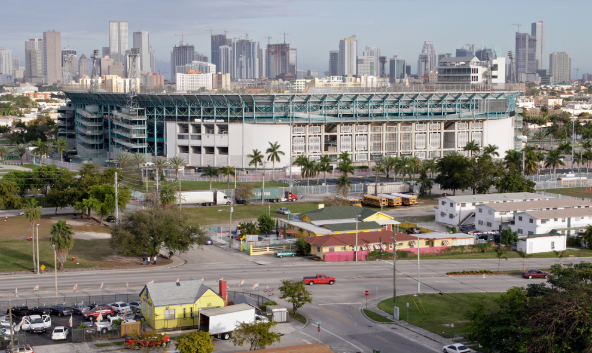

THEN → NOW
In 2007, the university announced that its football team would move its home games to what was then called Dolphin Stadium beginning with the 2008 season.
It was an emotional decision, to be sure.
Miami officials acknowledged the history and traditions of the Orange Bowl while pointing to the newer stadium’s modern facilities, amenities and infrastructure.
The final Hurricanes game at the Orange Bowl came on Nov. 10, 2007, a 48-0 loss to Virginia.
The Orange Bowl was demolished in 2008, and loanDepot Park, home of MLB’s Miami Marlins, now sits on the site.
NOW: Hard Rock Stadium
Opened in 1987 as Joe Robbie Stadium, the facility has gone through several names and transformations before becoming Hard Rock Stadium.
Miami moved there for the 2008 season and the contrast with the Orange Bowl was striking.
The old stadium was about 8 miles from campus.
The new one is about 20 miles away.
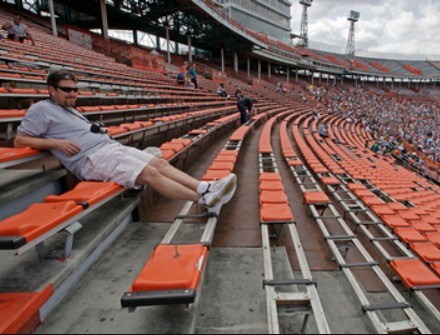
The Orange Bowl had thousands of bench-style seats and no fan video boards.
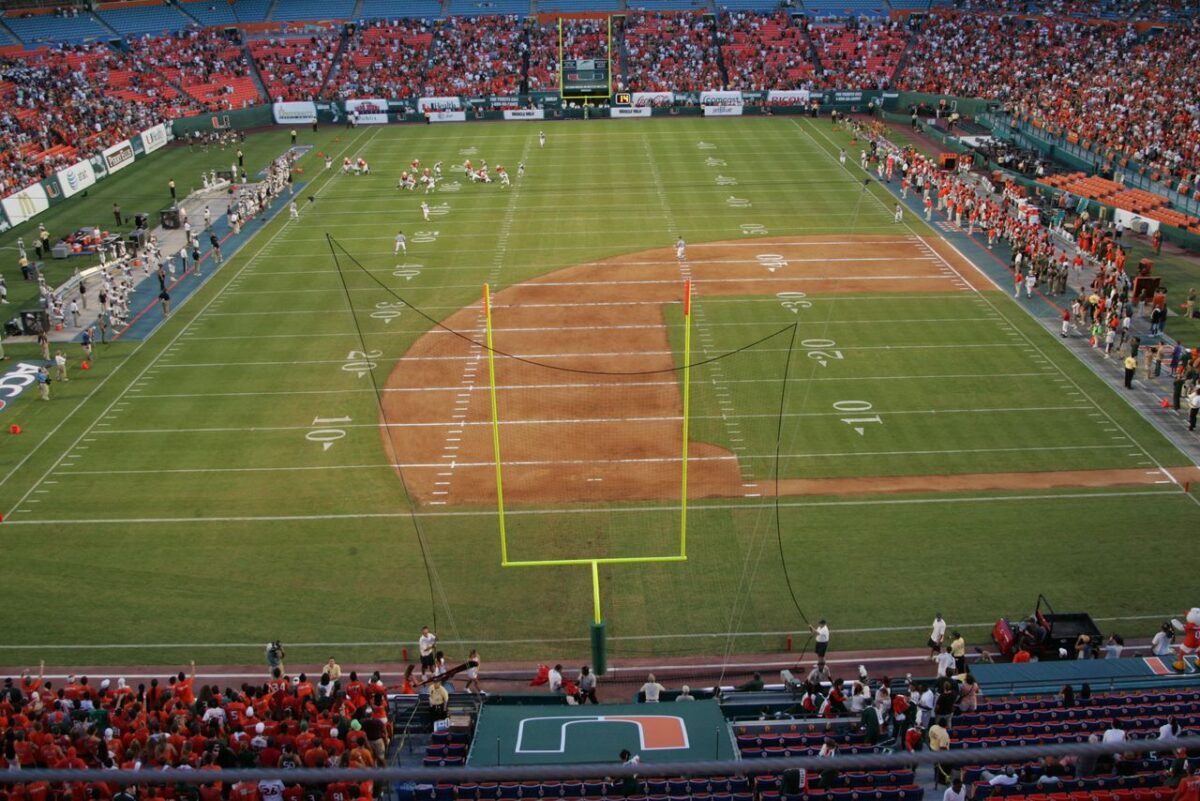
Hard Rock Stadium was built around chairback seating, suites, club areas, large video boards, expanded parking and the amenities expected of a modern professional sports venue.
The facility has continued to evolve, too.
In addition to be home to the Miami Dolphins and the Orange Bowl, it also has hosted Super Bowls and BCS and College Football Playoff championship games, including UM’s 27-21 loss to Indiana in last season’s title game.
Seven games in the 2026 FIFA World Cup were played there, and the Miami Open tennis tournament and Formula 1’s Miami Grand Prix also are held at the site.
In other words, the stadium reflects the way sports in Miami have changed.
So if the Orange Bowl was a Miami football institution, Hard Rock is a Miami sports destination.



THEN & NOW: Miami football
- 1937 — Miami moves into Roddy Burdine Municipal Stadium
- 1959 — The stadium becomes the Orange Bowl
- 1983 — Miami defeats Nebraska 31-30 for its first national championship
- 1987 — Miami completes a 12-0 season and wins its second national title
- 1989 — Miami beats Alabama in the Suger Bowl for its third national title
- 1991 — Miami wins its fourth national championship in nine seasons
- 2001 — Miami caps 12-0 season with rout of Nebraska in the Rose Bowl for fifth national title
- 2002 — A record crowd of 81,927 packs the Orange Bowl for Miami–Florida State
- 2007 — Miami plays its final season at the Orange Bowl
- 2008 — The Hurricanes move to Dolphin Stadium
- 2016 — The stadium becomes Hard Rock Stadium
- 2025 — Miami beats Texas A&M, Ohio State and Ole Miss in the College Football Playoff before losing to Indiana in the national championship game at Hard Rock
- 2026 — Miami continues its quest for a sixth national championship in a stadium that has become one of the country’s major sports venues
READ MORE: Is Miami still a college football blue blood? The numbers say yes
READ MORE: 5 things every Miami college football fan needs to experience at least once
READ MORE: Miami among exclusive club of programs with 3 No. 1 overall NFL draft picks
Mike Garbett is a content specialist working with McClatchy’s Content Innovation Lab.