



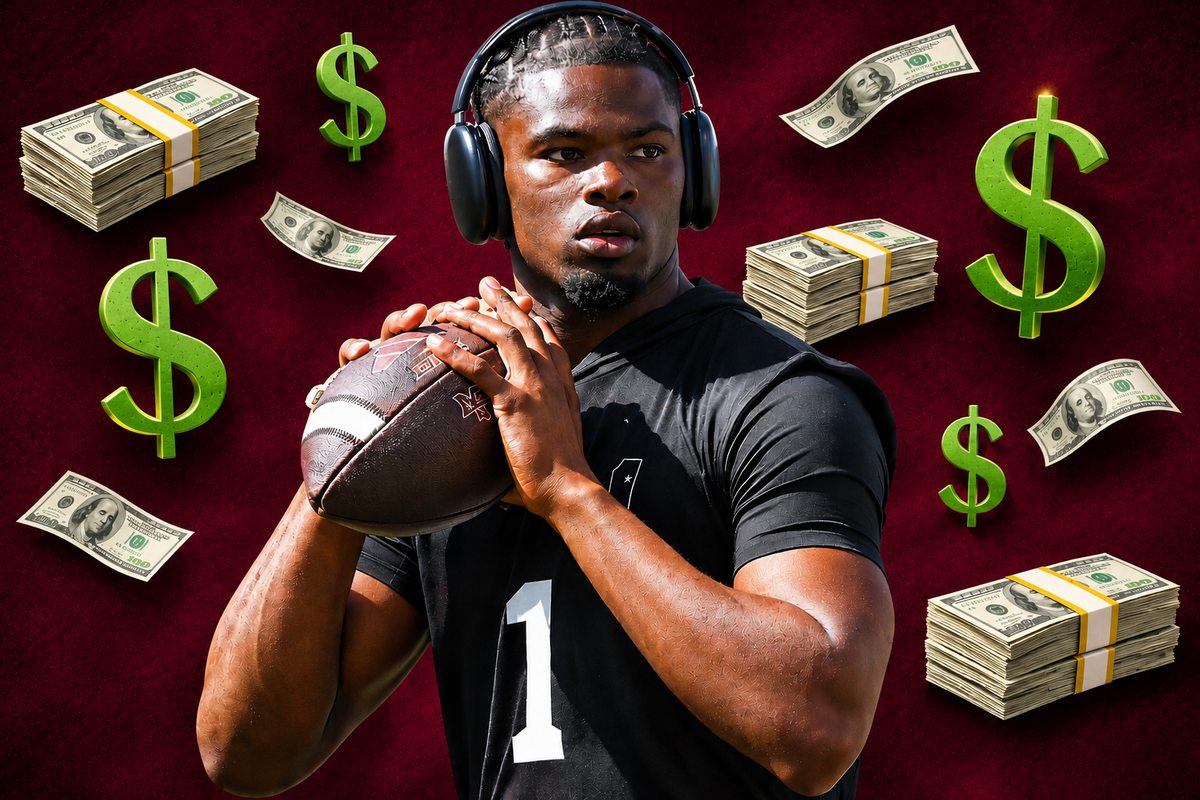
For $7.5 million, you could buy a game-worn Kobe Bryant rookie jersey, Joe Burrow’s Ohio mansion or the actual Fender Mustang guitar Kurt Cobain played in the “Smells Like Teen Spirit” music video. What $7.5 million can also get you, reportedly, is a college quarterback.
Electric signal-caller Kamario Taylor has reportedly agreed to return to Mississippi State, and On3 reports that his deal is worth a whopping $7.5 million, with incentives that could take it as high as $9 million. Needless to say, the figure is shocking, and it will reportedly make him college football’s highest-paid quarterback.
Taylor led the Bulldogs to a 4-0 start this season, with Mississippi State ranked as high as No. 16 in the AP poll, before having season-ending surgery for turf toe in late October. But, given his relative lack of experience and the gargantuan sum now attached to his name, you probably have … questions.
Luckily, we have answers. Student Section’s Mike Garbett, Ethan Cadeaux and Colin Ward-Henninger examined all the issues — and potential controversy — surrounding Taylor’s reported deal.
Editor's Picks
1. Is a college football player really worth $7.5 million, or have we officially lost our minds?
Mike: Yes and yes. First, kudos to Taylor for securing the reported $7.5 million. You’re worth whatever someone is willing to pay you, and if a program believes that kind of investment is warranted, good for him. That said, we’re talking about a quarterback with eight career starts who isn’t eligible for the NFL Draft. At some point, we have to ask whether college football has lost perspective. The money being thrown around is staggering, and while players deserve to benefit from their value, the current marketplace is becoming increasingly difficult to justify.
Ethan: Before his injury, there was no player in college football more exciting than Kamario Taylor this season. He made Mississippi State football must-watch TV, something that hasn’t happened since Dak Prescott left campus a decade ago. So, is he worth $7.5M? Yeah, of course he is. The going rate for star players seems to increase every year in the current wild west we call the name, image and likeness (NIL) era. I’m willing to bet that Taylor would have gotten that figure elsewhere, if not more, if he hit the portal. And I’m not sure if Mississippi State would ever recover if they lost Taylor, who grew up a diehard fan.
Colin: Ethan makes a great point here. This isn’t just about Taylor’s value as a college football player. This is about his value to Mississippi State. If the powers that be have determined that Taylor, a Mississippi native, will elevate Mississippi State to a true contender and become a face of the program who creates a whole new generation of Bulldog fans (eventually drawing the highest-level recruits), then it’s worth it to risk the $7.5 million to retain him. It’s surely a gamble given Taylor’s lack of proven on-field success, but that’s where we are right now. Mississippi State would rather put its chips on the table and risk going bust than watch Taylor potentially lead another program to the natty.
Reader vote: Is a college quarterback worth $7.5 million, or have we lost our minds? Cast yours on Student Section.
Fan vote
Is a college quarterback worth $7.5 million, or have we lost our minds?
You picked . Post it on X
Unofficial reader vote. One vote per browser.
2. Are multimillion-dollar player deals destroying what made college sports special for fans?
Colin: For years I covered the NBA, where fans are often more interested in free agency and trades than the actual games. This is where college sports are seemingly headed. The fear is that the emphasis will shift almost entirely from the on-field results to the transfer portal and NIL dollar amounts, leaving college sports too closely resembling their more businesslike professional counterparts. That being said, college sports fans’ loyalty, by nature, lies with the school and the programs rather than being tied to specific players. In that sense, even all this movement and money won’t diminish the pride of those who bleed their institution’s colors.
Mike: Seeing reports about players re-signing with their teams and negotiating multimillion-dollar deals isn’t what college football is supposed to be about. Like Colin said, this isn’t the NBA. Fans used to connect with players and take pride in watching them represent a school for three or four years. Now, too often, the conversation revolves around contracts, agents, NIL valuations and the transfer portal. That’s not to suggest players shouldn’t get paid. They absolutely should. But when the business of college football becomes the story, the game and its traditions risk becoming secondary.
Ethan: After years of college athletes not being paid their worth (legally, at least), I will never fault them for chasing the highest bag. That said, the NIL era has completely changed the sport, and I’m not sure for the better. More money has led to more player movement, and it’s hard for fans to keep up. I agree with Mike: Gone are the days of seniors spending all four years at one school, something that used to make college sports special. I wish there were a middle ground where players were paid without the transfer movement we see today, but we just haven’t been close to finding that compromise.
3. If you had $7.5 million to spend on a college football program, would you give it to one potential star or spread it across the roster?
Ethan: You have to spread it around the roster. If one player is making all the cash, that will certainly create some locker room issues — even if the $7.5M player is the most genuine, humble person on the planet (something that might not necessarily be the case). Yes, you need to pay up for a star quarterback in today’s market, and it’s quite difficult to win without one. But football is the ultimate team sport. You’re not winning many games without depth and talented players on both sides of the ball.
Mike: Spread it around, without question. Yes, one superstar, especially at quarterback, can make a big difference, but, like Ethan said, football is still the ultimate team sport. You need depth, playmakers on both sides of the ball and quality players who can step in when injuries inevitably happen. What’s the point of paying one player $7.5 million if you don’t have the talent around him to succeed? Let’s build a roster, not a highlight reel.
Colin: Like Teddy KGB said, “Pay that man his money.” I certainly appreciate the “ultimate team sport” angle, but there are two reasons I’d pay up for an elite quarterback. First, a great QB elevates everyone around them. If Taylor can turn an average supporting cast into a good one, Mississippi State doesn’t need higher-level (more expensive) recruits at those positions. And if the offense is putting up 45 per game, you don’t need to spend for a top-tier defense. Second, like I mentioned before, this isn’t just about on-field success. You’re building a brand — a coveted destination for recruits, transfers and coaches. Having a popular, charismatic superstar goes a long way in that department.
4. Will the NIL arms race eventually make college football more competitive, or turn everyone outside the richest programs into permanent losers?
Mike: “Permanent losers” might be a stretch. Ohio State, Oregon, LSU and Texas A&M are all reportedly in the $50 million or more range in estimated roster and NIL spending this season, yet all could find themselves on the outside looking in when the College Football Playoff field is announced. Of course, the programs with the deepest pockets will have an advantage when it comes to attracting and retaining talent. But money doesn’t guarantee wins, chemistry or championships. And with the playoff expanding to 24 teams in 2027, more programs will have a path to the postseason. The gap between the haves and have-nots may grow, but the richest programs won’t automatically own college football.
Ethan: I largely agree. I’ll never be able to call another school a permanent loser after seeing what’s happened at Indiana the last three years. The Hoosiers were, literally, permanent losers before Curt Cignetti arrived. Now, they are defending national champions and poised to go on another deep run this season. Yes, they have a lot of funding with the largest alumni base in America, which certainly helps. But money doesn’t buy championships. We’ve seen big-time programs like Texas A&M, LSU and others spend reportedly $50M+ on their roster and not sniff a title. Having financial backing is certainly an advantage, but having a good coaching staff that’s able to recruit and develop talent is just as important, if not more so.
Colin: You’ll always have the outliers, but we’re fooling ourselves if we think spending doesn’t make a huge difference — especially in college football, where securing elite recruits is essential for success. In pro sports, teams like the Brewers and the OKC Thunder give the illusion that savvy personnel and shrewd decisions can make up for a lack of spending, but the reality is that four of the last five MLB and NBA champions have been in the top 10 in payroll, and the last two Super Bowl champs have been in the top five. Indiana was a Cinderella, but previous winners Ohio State, Michigan and Georgia aren’t exactly programs that are strapped for cash.
5. Ten years from now, will fans still care as passionately about college football if players are essentially professional athletes changing teams for the highest bidder?
Ethan: Yes, I’m optimistic. In college sports, fans typically care more about the front of the jersey than the back. Players have always come and gone, but school pride never varies. The traditions, pageantry, rivalries and history that make college football great are still alive and well, even if roster turnover is more frequent on an annual basis. If anything, increased player movement will lead to more spice, especially if players move within conference. Take Parker Livingstone as an example. He was Arch Manning’s roommate at Texas last year and one of his top targets. Well, he transferred to Oklahoma, which naturally became a big storyline ahead of the Red River Rivalry. It certainly provided added intrigue ahead of one of the biggest games of the year.
Colin: Yes, with a caveat. If there’s one thing we’ve learned about college sports, it’s that the passion doesn’t die. I do think that the focus 10 years from now could shift, however, to more off-the-field drama. Overall engagement could actually increase given all the arguments that have been and will continue to be generated over transfers and dollar figures for players, but the passion for the game itself might actually wane slightly. As Ethan said, the traditions and history aren’t going anywhere, but fans might end up further channeling their passion and energy onto social media instead of into the stands as a result of the obscene amount of player movement.
Mike: In a word, yes. College football is bigger than the players wearing the uniform. It’s about school pride, rivalries, traditions, Saturdays with family and friends, and generations of fans who have spent their lives cheering for their team. The business of college football may look completely different 10 years from now, and fans may have to get used to a revolving door of players and multimillion-dollar deals. What won’t change: The passion fans have for their schools. The names on the jerseys change. The loyalty in the stands doesn’t.