
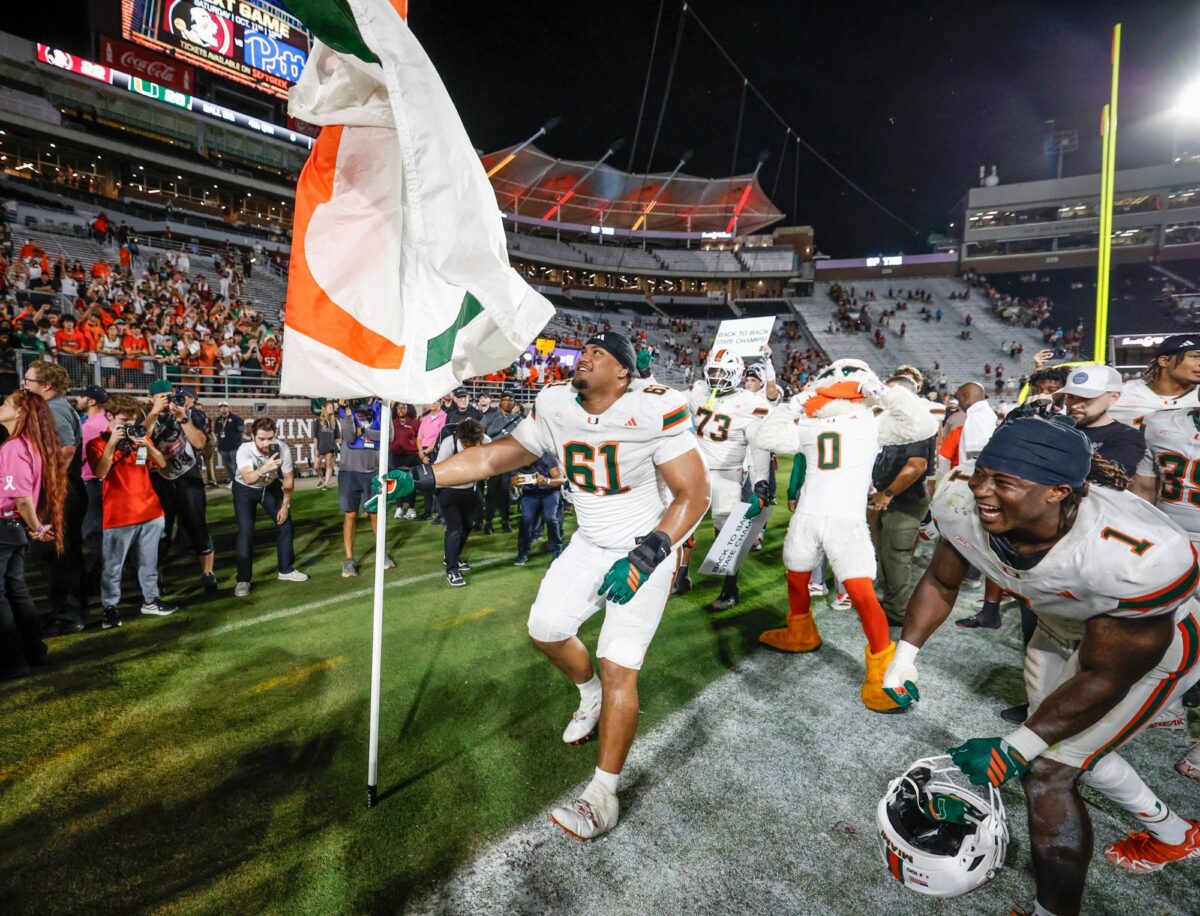
Not many college football rivalries have produced the drama of Florida State and Miami.
The schools are separated by roughly 500 miles, but for decades their programs have been locked in a fight for national relevance and, of course, state supremacy.
The rivalry began in 1951, when Miami won the first meeting 35-13. Over seven decades later, the Hurricanes hold a 37-33 edge heading into the Oct. 17 matchup (7 p.m. ET, ESPN) at Hard Rock Stadium in Miami Gardens.
The numbers, though, only begin to explain why this game has become one of college football’s most recognizable rivalries.
So much so, we ranked it seventh among the 25 rivalries that define college football.
For much of the 1980s, 1990s and early 2000s, Florida State and Miami weren’t just competing for bragging rights. They were competing for national championships.
Since 1983, the programs have combined to win eight national titles — five for Miami and three for Florida State.
Miami won championships in 1983, 1987, 1989, 1991 and 2001.
Florida State captured titles in 1993, 1999 and 2013.
At the height of the rivalry, it was common for the winner of Florida State-Miami to have a direct impact on the national championship race.
And few games demonstrated that better than the 1991 meeting.
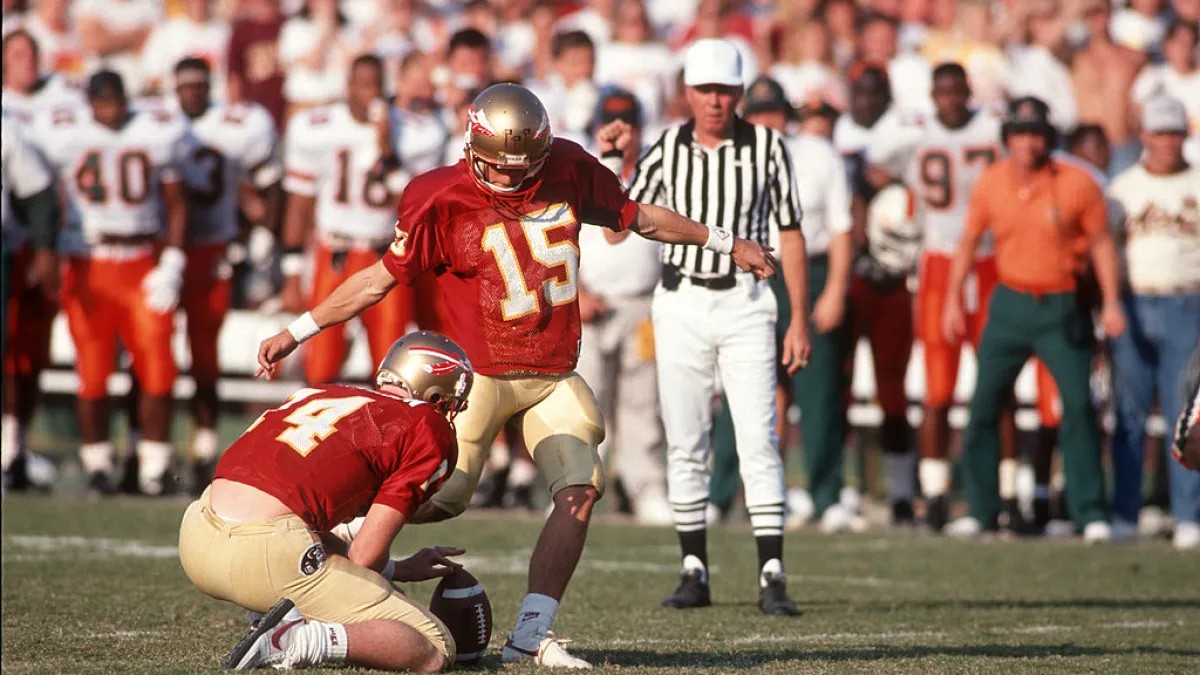
Wide Right
No. 1 Florida State hosted No. 2 Miami in ’91 in what was billed as the “Game of the Century.”
The Seminoles led 16-7 in the third quarter, but Miami rallied and took a 17-16 lead with 3:01 remaining. But Florida State drove into position for a potential game-winning field goal.
Then came the moment that would define the rivalry for years.
Gerry Thomas’ 34-yard attempt sailed wide right with 29 seconds left.
UM held on to win by one, and Wide Right became part of Florida State-Miami vocabulary.
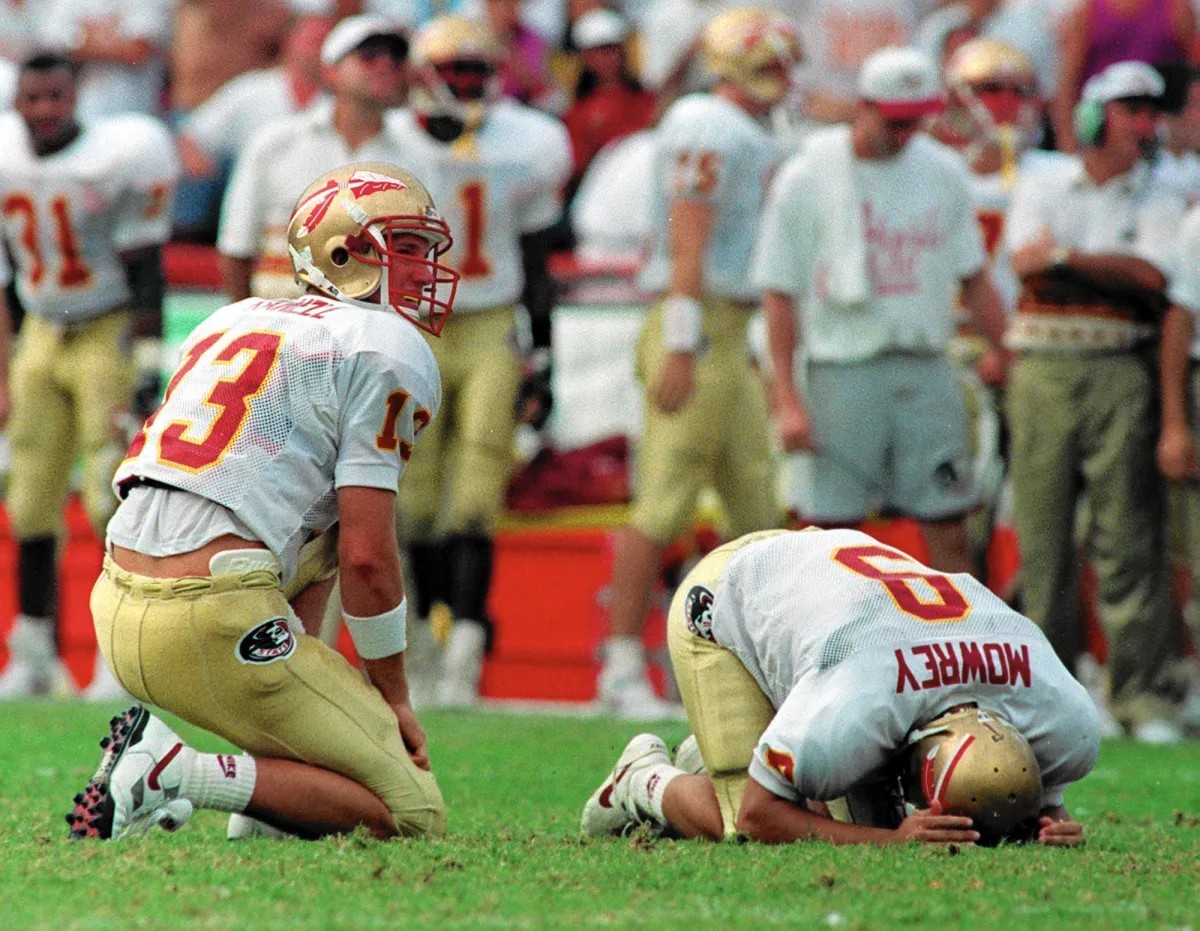
Wide Right II
The next year, it happened again.
In 1992, visiting Florida State drove into position late against Miami, only for Dan Mowrey’s 39-yard attempt to sail aimlessly to the right — Wide Right II — on the game’s final play.
Miami won 19-16.
In 1993, Florida State finally broke through, beating Miami 28-10 on its way to the Seminoles’ first national championship.
But the kicking drama wasn’t finished.
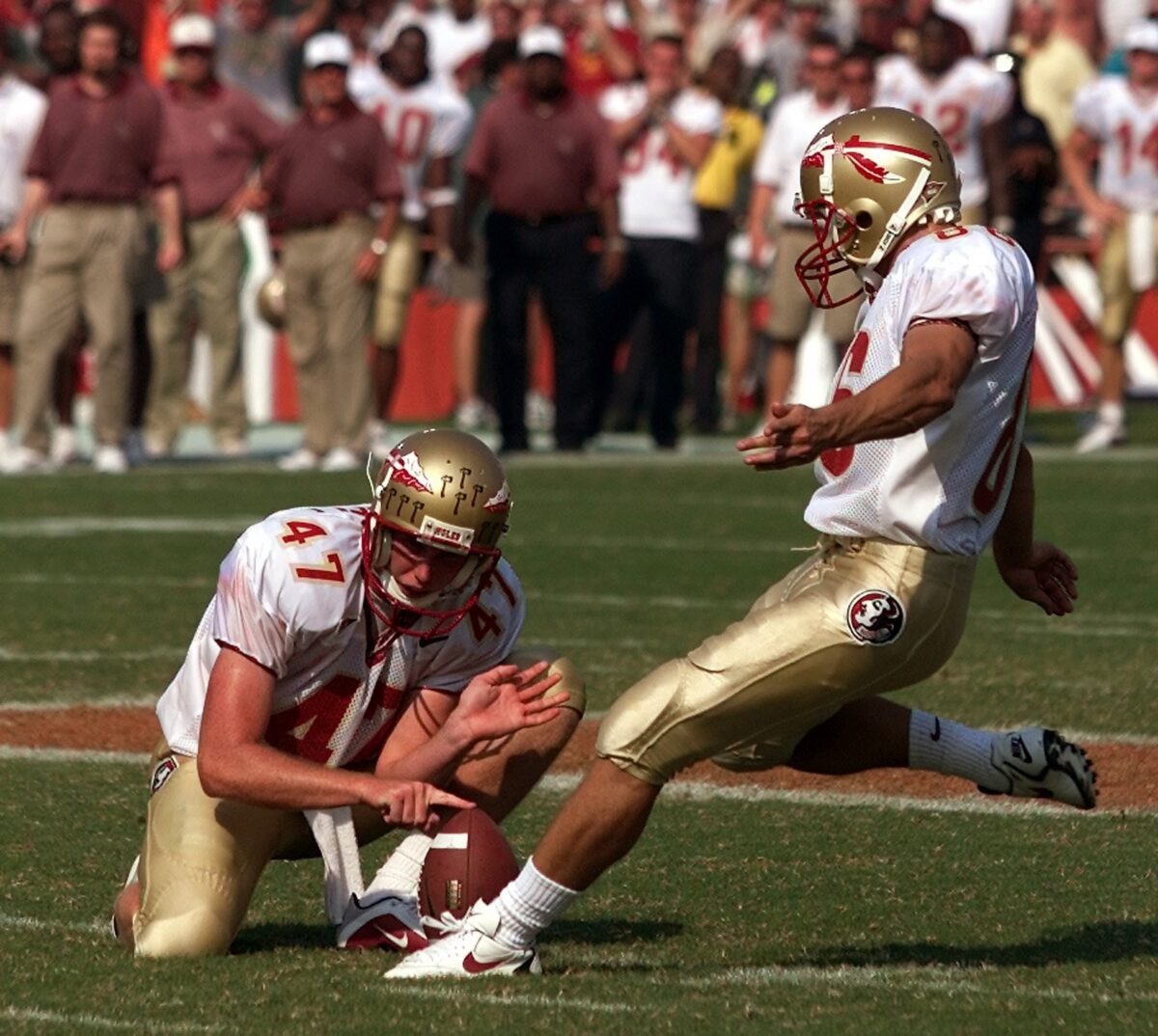
Wide Right III
In 2000, No. 1 Florida State traveled to Miami with another national championship run at stake.
The Seminoles had rallied from a 10-point deficit and had a chance to tie it, but Matt Munyon’s 49-yard field goal attempt was no good — Wide Right III — as time expired.
Miami won 27-24.
Even Miami players, including wide receiver Reggie Wayne, understood how bizarre the pattern had become: “The only thing going through my mind was Wide Right one, Wide Right two, and I was hoping there would be a Wide Right three.”
There was, and the rivalry later added another variation.
Wide Left
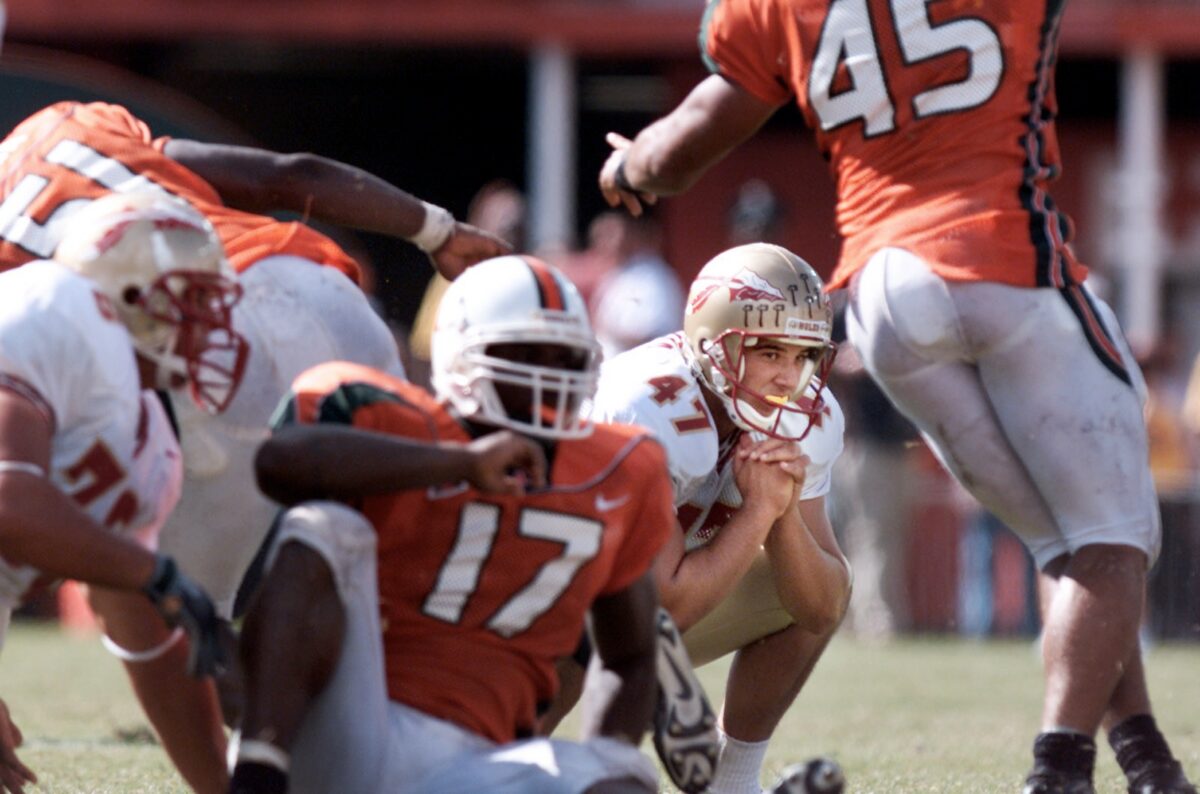
In 2002, Xavier Beitia’s 43-yard attempt went wide left on the game’s final play, allowing No. 1 Miami to escape with a 28-27 victory.
It was another gut punch for Florida State in a rivalry that had already developed an uncanny relationship with missed field goals.
With the defending national champion Hurricanes trying to protect an undefeated season, Beitia’s miss added a new direction to the growing legend: Wide Left.
Wide Right IV
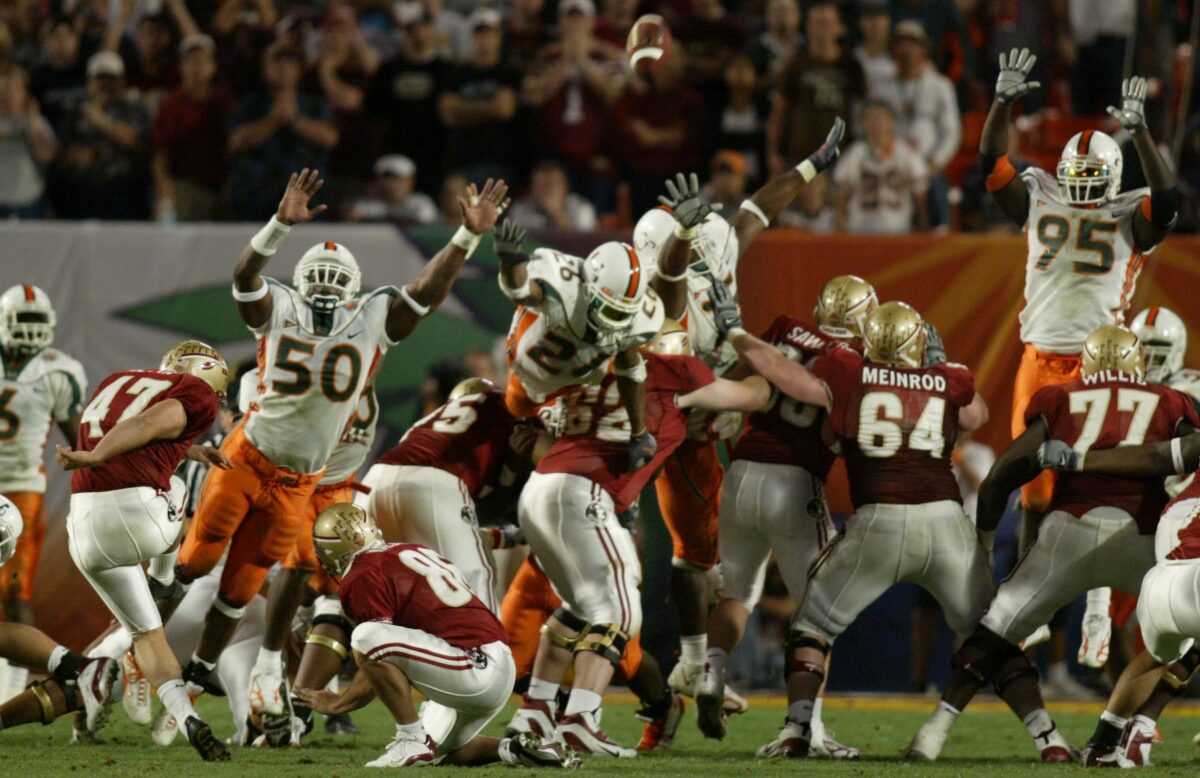
Then came the 2004 Orange Bowl, the only postseason meeting between the teams.
With Miami leading 16-14 late in the fourth quarter, Beitia missed another decisive field goal, this one from 39 yards.
The Canes held on for a 16-14 win.
Miami linebacker Jonathan Vilma offered perhaps the most colorful explanation.
“We’ve got something on their kicker,” Vilma said. “I don’t know what it is, but I’m glad we got it.”
Fellow linebacker D.J. Williams had another theory: “It feels great to beat anyone, but it’s especially sweet to beat your biggest rival. Maybe it’s a mystique, some kind of a curse. I know it’s always in the back of their kicker’s mind.”
The missed kicks became such a defining part of the rivalry that former FSU coach Bobby Bowden eventually joked about what his legacy against Miami might look like.
“As good as we were, we didn’t win a national championship until 1993, mainly because we kept losing to Miami on missed kicks. I used to get mad because nobody else would play Miami. Notre Dame would play them, then drop them. Florida dropped them. Penn State dropped them,” Bowden said.
“We would play Miami and lose by one point on a missed field goal, and it would knock us out of the national championship. I didn’t want to play them either, but I had to play them. That’s why I said, ‘When I die, they’ll say, ‘At least he played Miami.’”
The stakes go beyond the standings
That line captured something important about the series.
Florida State couldn’t avoid Miami. And Miami couldn’t avoid Florida State.
The programs kept meeting as their fortunes rose and fell, with generations of players inheriting the history from those who came before them.
The intensity hasn’t disappeared, either.
In 2018, the Miami Herald described the tension between the teams as players from both sides were separated by officials at halftime to prevent an altercation.
“That’s just the rivalry,” FSU linebacker Dontavious Jackson said at the time. “A lot of us know each other. We’re playing for bragging rights and we want to win the game.”
Miami players have described the feeling similarly.
In 2021, Miami cornerbacks coach DeMarcus Van Dyke put the importance of the rivalry simply: “You don’t remember any record but this record right here.”
A rivalry built for the national stage
The rivalry has produced plenty beyond missed kicks.
It has featured Heisman Trophy winners, NFL stars, undefeated teams, championship contenders and games between some of the best teams in college football history:
- In 1991, it was No. 1 Florida State against No. 2 Miami.
- In 1993, Florida State’s victory helped clear the way for its first national championship.
- In 1999, the Seminoles entered the Miami game undefeated and ranked No. 1. Miami ended that perfect season with a 27-24 victory.
- In 2001, Miami’s eventual national championship team beat Florida State 28-27.
- In 2013, Florida State was back at the top of the sport, and the Seminoles beat Miami 41-14 during their run to a third national championship.
Those games helped make the rivalry about more than Florida.
They made it about college football’s biggest stage.
On Oct. 17, they’ll get another chance.
Florida State and Miami will meet again, adding another chapter to a rivalry that has spent decades producing speed, swagger, bad blood, national championship implications and some of the most unforgettable finishes in the history of college football.
READ MORE: The top 25 college football traditions that make Saturdays special
READ MORE: These 13 in-state college football rivalries divide families and split coworkers
READ MORE: The ultimate road trip for ACC football fans: Five stadiums, five weekends
READ MORE: Three Florida college football traditions make top 25. Here’s where they rank
READ MORE: These 3 Florida college football rivalries rank among the nation’s best
READ MORE: Every school with a Heisman winner: Where do UF, FSU and UM stack up?
More Florida State coverage
Tradition Tuesday: The story of FSU’s Osceola and Renegade pregame ritual
5 things every Florida State football fan needs to experience at least once
FSU football traditions that bring Tallahassee, Doak Campbell Stadium to life
College football’s best pregame entrances: 5 traditions that stand out
ACC dominates college football’s best pregame entrances with these 3 traditions
More Miami coverage
How Miami’s Turnover Chain tradition started … and where it went
Then & Now: Miami football from the Orange Bowl to Hard Rock Stadium
5 things every Miami college football fan needs to experience at least once
Is Miami still a college football blue blood? The numbers say yes
Miami among exclusive club of programs with 3 No. 1 overall NFL draft picks
Mike Garbett is a content specialist working with McClatchy’s Content Innovation Lab.