

College basketball is built on tradition. From legendary coaches and iconic arenas to national championships and unforgettable March Madness runs, a select group of programs has separated itself from the rest of the sport.
But what exactly makes a college basketball program a blue blood?
It takes more than multiple national championships or a few years of dominance. The sport’s true blue bloods have built decades of success and remained relevant across different eras.
UCLA, Kentucky, North Carolina, UConn, Duke, Indiana and Kansas are almost universally recognized as members of that group. You know, teams with decades of dominance, enduring prestige and, of course, national championships.
Lots of national championships.
Other programs have built impressive résumés of their own, but these seven have the combination of history, hardware and staying power that defines college basketball’s elite.
Let’s dive into the numbers:
Blue bloods
College basketball’s gold standard, the exclusive club at the top of the sport. The seven teams with five or more national championships:
UCLA (11 titles)
Championship seasons: 1964, 1965, 1967, 1968, 1969, 1970, 1971, 1972, 1973, 1975, 1995
The legacy: No program has enjoyed a championship run like the Bruins. Under John Wooden, UCLA won 10 national championships in a 12-year span, including seven consecutive titles from 1967 through 1973. The program’s extraordinary dominance and historical accomplishments under Wooden remain unmatched.
Kentucky (8 titles)
Championship seasons: 1948, 1949, 1951, 1958, 1978, 1996, 1998, 2012
The legacy: With their eight crowns, a long list of legendary players and a passionate fan base, the Wildcats have established a standard that few schools can approach. From Adolph Rupp to John Calipari, and with its championship history and national following, Kentucky has remained one of the sport’s biggest names across multiple generations.
North Carolina (6 titles)
Championship seasons: 1957, 1982, 1993, 2005, 2009, 2017
The legacy: The Tar Heels’ combination of championships, legendary coaches and sustained excellence make them one of college basketball’s most prestigious programs. UNC has also produced some of the sport’s greatest players. Dean Smith and Roy Williams helped establish the program’s identity, and Michael Jordan became one of its most recognizable alumni.
UConn (6 titles)
Championship seasons: 1999, 2004, 2011, 2014, 2023, 2024
The legacy: The Huskies won six national titles over 26 seasons, spread across multiple coaching eras. Their championship runs under Jim Calhoun, Kevin Ollie and Dan Hurley demonstrate that their success is not limited to one era. Moreover, UConn’s dominant back-to-back titles in 2023 and 2024 strengthened their place in history.
Duke (5 titles)
Championship seasons: 1991, 1992, 2001, 2010, 2015
The legacy: The Blue Devils’ rise into the sport’s elite ranks accelerated under Mike Krzyzewski, who transformed the program into a perennial championship contender. Duke consistently attracts elite recruits and huge national television audiences, and its success has continued across several generations of players.
Indiana (5 titles)
Championship seasons: 1940, 1953, 1976, 1981, 1987
The legacy: Among the Hoosiers’ five national titles is the undefeated 1975-76 team, the last time a men’s Division I team completed a championship season with a perfect record. Bob Knight’s teams helped establish Indiana as one of the sport’s premier programs, and the program’s historical achievements remain impressive despite a lack of recent success.
Kansas (4 titles)
Championship seasons: 1952, 1988, 2008, 2022
The legacy: The program’s roots trace back to James Naismith, the inventor of the game, and its history and legacy extend beyond the four championship seasons. Even so, the Jayhawks have consistently remained among the nation’s top programs under Phog Allen, Roy Williams and Bill Self, who have kept Kansas in the national conversation across generations.
New bloods
The blue bloods have the history, the titles and the staying power. But college basketball’s landscape is always evolving, and two programs are close to joining that elite group.
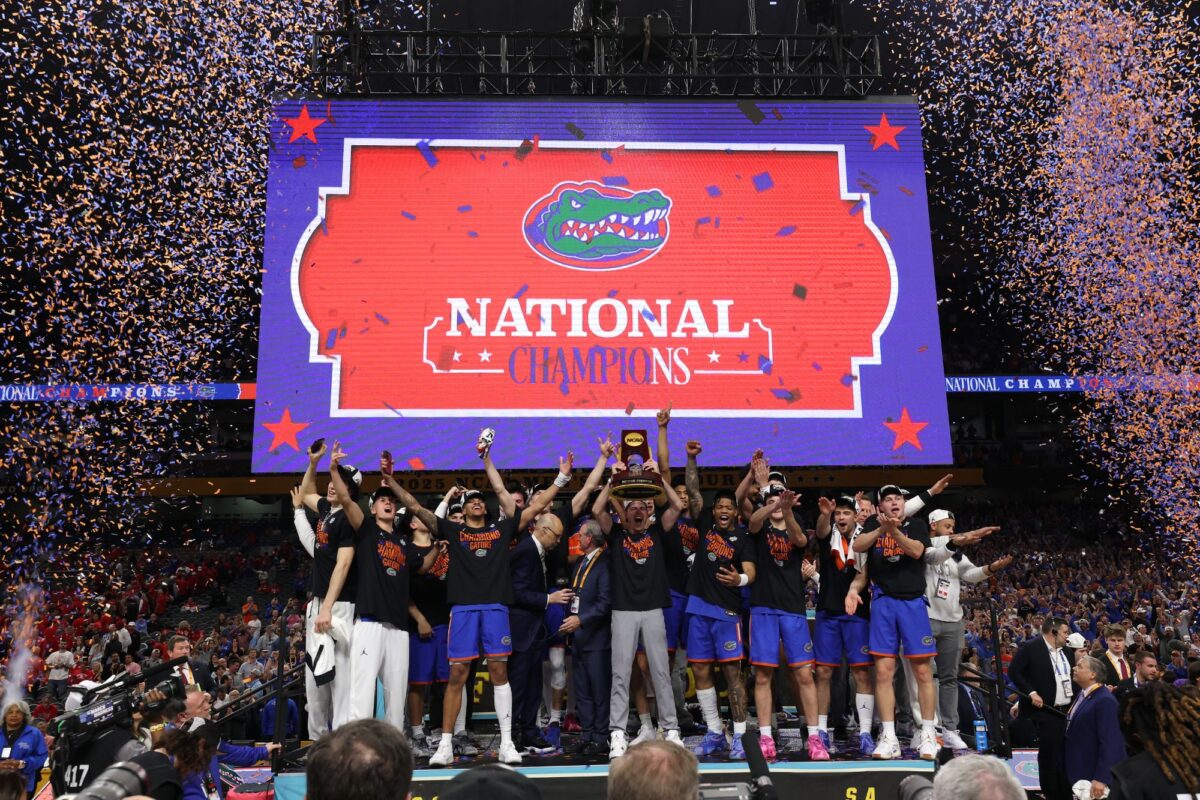
Florida (3 titles)
Championship seasons: 2006, 2007, 2025
The legacy: The Gators won back-to-back national championships under Billy Donovan, establishing themselves as one of the sport’s dominant programs during that period. Their 2025 crown under Todd Golden showed that Florida could return to the top in a different era.
Villanova (3 titles)
Championship seasons: 1985, 2016, 2018
The legacy: The Wildcats’ three titles feature the unforgettable 1985 tournament run under Rollie Massimino, capped by the upset win over Georgetown, as well as two crowns in three seasons under Jay Wright. The program has a long history of competing at a high level.
The next tier
Seven programs, including 2026 champion Michigan, have two national titles, putting them in rare company. Still, all have a lot of work to do before entering the blue-blood conversation.
The teams: Cincinnati (1961, 1962); Louisville (1980, 1986); Michigan (1989, 2026); Michigan State (1979, 2000); N.C. State (1974, 1983); Oklahoma State (1945, 1946); and San Francisco (1955, 1956).
Louisville also won the national championship in 2013, but the NCAA vacated the title four years later after a program-related infractions case.
The bottom line
College basketball’s blue bloods are defined by more than winning. They combine championships, tradition, sustained excellence and a presence that transcends individual players and coaches.
The difference between being an elite program and a blue blood is simple: Elite programs win championships, but blue bloods build legacies that last for generations.
Mike Garbett is a content specialist working with McClatchy’s Content Innovation Lab.